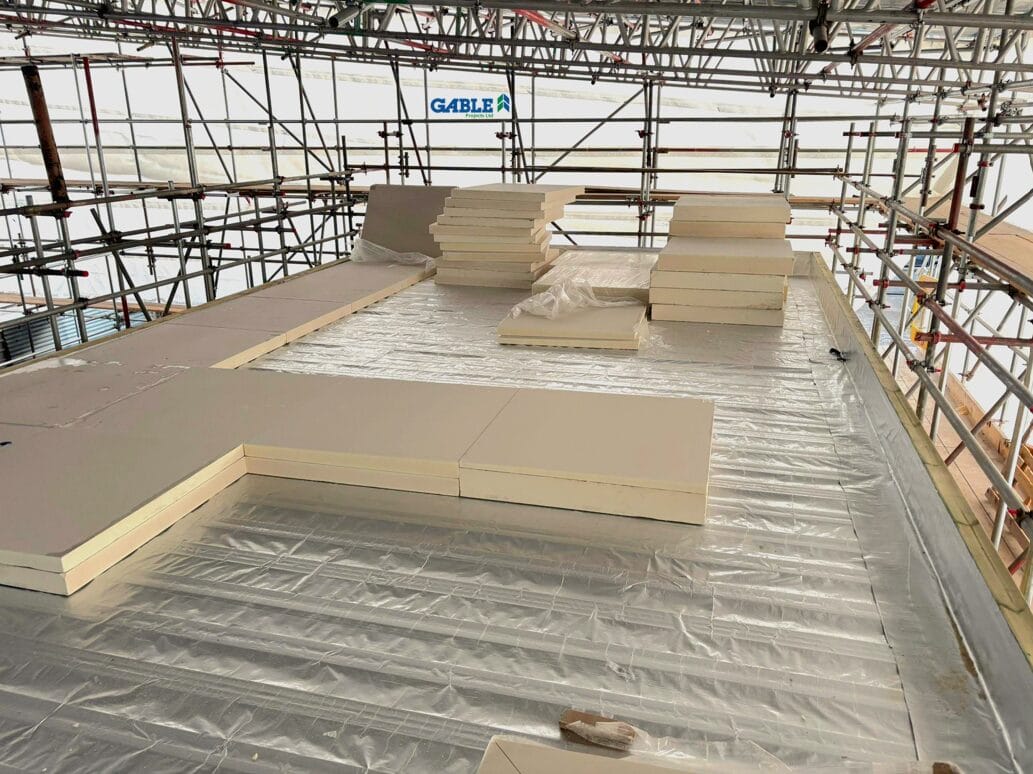
When planning a commercial flat roofing project, one of the most critical decisions is the choice of insulation. Two common approaches dominate the market: flatboard insulation and tapered insulation schemes. Each has its unique advantages, considerations, and applications. Understanding the differences between these insulation systems can save time, reduce costs, and improve the long-term performance of your roof.
Understanding Flatboard Insulation
Flatboard insulation is the traditional choice for commercial flat roofs. It typically consists of rigid insulation boards, such as PIR (polyisocyanurate), EPS (expanded polystyrene), or XPS (extruded polystyrene), laid in a flat, uniform layer across the roof deck.
Key Characteristics:
- Purpose: Provides thermal insulation and energy efficiency. Flatboard insulation primarily aims to maintain consistent roof temperature and reduce heat loss.
- Installation: Boards are installed in a straightforward, uniform layout. They can be mechanically fixed or adhered to the roof deck, which often makes installation faster for simple roof layouts.
- Availability: Widely available, with multiple thicknesses and compressive strengths suitable for most commercial projects.
- Cost: Generally less expensive than tapered systems, both in material and installation labour, due to the simplicity of design.
Flatboard insulation is ideal for roofs with minimal drainage complexity. However, one limitation is the potential for water pooling. Without slope, water may collect in low spots, potentially leading to leaks or membrane deterioration over time.
Understanding Tapered Insulation Schemes
Tapered insulation takes flatboard a step further. It involves insulating boards cut or manufactured at varying thicknesses to create a slope toward drains or scuppers. This system ensures proper water drainage, which is essential for preventing ponding water.
Key Characteristics:
- Purpose: Designed to solve drainage challenges on flat roofs. By creating a slope, tapered insulation reduces the risk of standing water and prolongs the life of the roofing membrane.
- Installation: Slightly more complex than flatboard. Each board must be placed according to a slope plan. While installation may take longer, the result is a more functional roof.
- Availability: Also widely available, though specialized cutting or prefabricated tapered boards may have lead times depending on thickness, slope requirements, and supplier.
- Cost: Generally higher due to increased material usage (thicker boards in certain areas), fabrication costs, and longer installation times.
Tapered insulation is particularly valuable on large roofs or buildings where water pooling is a concern. Properly designed tapered systems also improve energy efficiency, as water drainage prevents cold spots and potential thermal bridging.
Cost Comparison
- Flatboard Insulation: Lower upfront cost. Easier to install, reducing labour expenses. Ideal for small to medium sized or uncomplicated roofs.
- Tapered Insulation: Higher upfront cost due to specialized design and additional material. May increase installation time, but prevents long-term maintenance costs associated with potential ponding water.
Ultimately, while flatboard might save money initially, tapered systems can reduce lifecycle costs if the roof structure itself does not have adequate falls.
Installation Time and Considerations
- Flatboard: Quick and straightforward. Installation teams can often complete a standard roof in fewer days, assuming a simple layout.
- Tapered: Requires careful planning, potentially using CAD-generated slope plans. Each board must be fitted correctly to achieve the desired drainage. While labour-intensive, this investment pays off in durability and roof performance.
Choosing the Right Insulation
- Project Complexity: Flatboard is suitable for smaller, simple roofs; or those with pre-installed falls in the layout, whereas tapered is preferred for large or drainage-challenged roofs.
- Budget: Flatboard works well for tight budgets, but tapered insulation may protects against costly maintenance later.
- Performance Goals: If water pooling is a concern, tapered insulation ensures longevity and efficiency.
Energy Saving and Efficiency
Both flatboard and tapered insulation deliver strong energy efficiency and achieve compliant U-values for commercial flat roofs. Flatboard provides a consistent thermal layer, while tapered insulation offers reduced thermal bridging. Both options help minimize heat loss, lower energy bills, and maintain long-term roof performance.
Other factors to consider include local building regulations, roof load capacity, and compatibility with roofing membranes. Some projects may even combine both systems: flatboard over most areas with tapered zones around drains to optimize both cost and performance.
Conclusion
Choosing between flatboard and tapered insulation is not just about upfront cost—it’s about long-term performance, drainage efficiency, and project-specific needs. Flatboard insulation remains a cost-effective, readily available solution for uncomplicated roofs, while tapered insulation schemes provide superior drainage, where required and long-term durability, especially on larger or complex commercial projects.
By understanding the differences, project managers, architects, and building owners can make informed decisions, balancing cost, installation time, and performance to deliver a successful commercial flat roofing project.